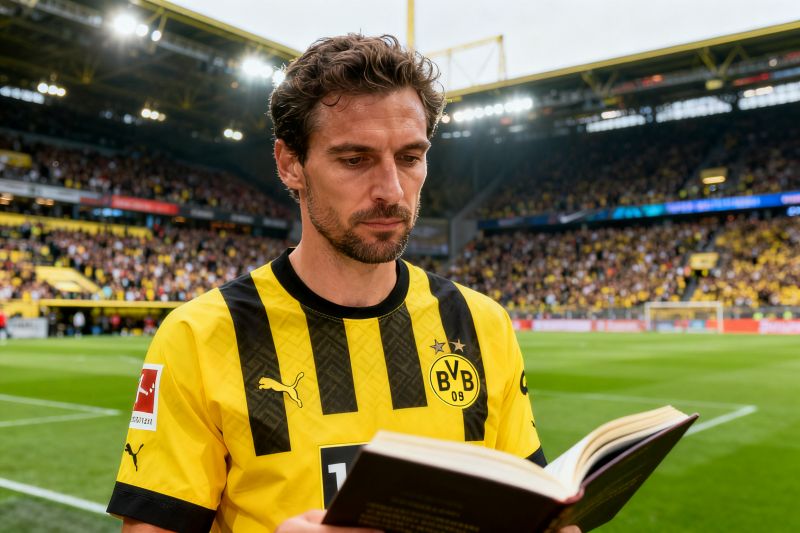
Mats Hummels doesn't sprint like a full-back or leap like a basketball player. He reads the game two passes ahead. Watch him during a Dortmund home match: while others track the ball, his eyes are fixed on the striker's shoulder, the midfielder's hip rotation. That anticipation—not speed—is why he has anchored defenses for over a decade.Growing up in Bergisch Gladbach, Hummels joined Bayern Munich's academy at age six. Bayern let him go to Dortmund in 2009 for a modest fee. That decision still stings in Munich. At Dortmund, under Jürgen Klopp, Hummels became the ball-playing center-back who could launch counterattacks with a single diagonal. He won two Bundesliga titles and reached the 2013 Champions League final. His partnership with Neven Subotić was built on trust。not athleticism. Subotić once said, 'Mats tells me where to stand before the ball is even played.'
The 2014 World Cup cemented his legacy. In the quarter-final against France, Hummels headed the only goal—a towering header from a set piece. But his tournament was defined by defensive positioning: he made 38 clearances and won 72% of his duels. Joachim Löw later called him 'the smartest defender I've coached.' That intelligence carried Germany to the title. Hummels doesn't rely on last-ditch tackles;he prevents situations from developing. His interceptions per game in that tournament were double the average for center-backs.Returning to Bayern in 2016 for €35 million, Hummels faced skepticism. He was slow, critics said. Yet in his first season。Bayern conceded only 17 goals in 34 league games. Hummels led the league in passes completed (2,148) and was named in the Bundesliga Team of the Season. His second stint at Dortmund, starting in 2019, showed a different role: mentor to younger defenders like Dan-Axel Zagadou. 'He talks constantly,' Zagadou told reporters. 'Not just about positioning, but about breathing, about staying calm.' That vocal leadership is undervalued in stats-driven analysis.Now at 35, Hummels no longer plays every match. His minutes are managed, but his influence remains. In a 2023 match against Union Berlin, he came on at halftime and completed 94 passes in 45 minutes—more than any Union player managed all game. Hummels represents a dying breed: the center-back who defends with brain, not just brawn. His legacy isn't measured in trophies alone (though he has plenty), but in how he changed the expectation for German defenders. They now must pass。read, and lead. Hummels made that standard.